The European Environmental Bureau and WWF launch benchmarks for Europe’s water policy: Europe’s water at the crossroads. Five headline indicators are presented to measure progress in the ongoing water management reforms under the EU Water Framework Directive. The indicators look at issues like transparency and public onwership of river basin management, provision of more space and water to enhance aquatic ecosystems and making them more resilient to climate change.
Scheuer, S. (2008). Europe’s water at the crossroads. Brussels: EEB and WWF.
Throughout the world there is increasing public awareness of the importance of sustainable water management to meet both growing human demands and ecosystem needs. Predictions of increased climate variability and indicators of ecological and water quality deterioration have made water management a salient political issue, particularly in arid climate regions such as western North America and the Iberian Peninsula. In recent years, substantial effort has been focused on adopting sustainable water use practices and mitigating the impacts to natural rivers and streams resulting from human activities. Yet the restoration of natural biological communities has been more difficult than anticipated. Our inability to effectively restore and protect rivers and groundwater sources are in part due to the scale of environmental damage inflicted upon them, but also are a consequence of the legal and institutional frameworks under which water is managed. Assessments of the current state of the world’s water resources suggest that conventional approaches to water management will be inadequate to sustainably balance human and ecosystem needs into the future. Furthermore, as nations around the world struggle with water management challenges, there has been little explicit attempt for one region to learn from the experience of another in approaching common problems.
The
European Union’s Water Framework Directive (WFD) defines a new strategy
for meeting human water demands while protecting environmental
functions and values and may be helpful in informing water management
practices and policies in other regions of the world. In the report we
explore how the management approach described under the WFD compares to
the legal and institutional system of a California river basin, managed
under distinctly different principles and objectives. Through a
theoretical application of the WFD, we highlight the critical water
management challenges of northern California’s Russian River basin and
use the Directive’s approach to develop strategic recommendations for
water management reform.
A Fresh Perspective for Managing Water in California:Insights from Applying the European Water Framework Directive to the Russian River Ted Grantham, Juliet Christian-Smith, G. Matt Kondolf, and Stefan Scheuer University of California, Water Resources Center Contribution #208 ISBN-13: 978-0-9788896-2-3; ISBN-10: 0-9788896-2-2 March 2008
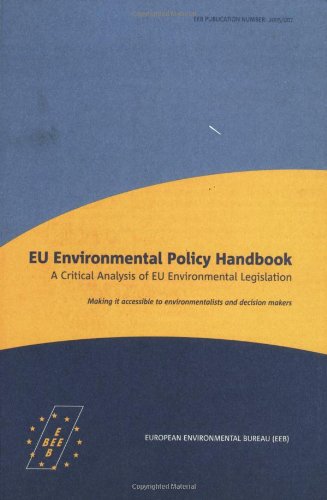
Scheuer, S. (Ed) (2005). EU Environmental Policy Handbook, A critical Analysis of EU Environmental Legislation – making it accessible to environmentalists and decision makers. 344 pp. Brussels: European Environmental Bureau.
In order to facilitate the use of our website, we use cookies.
Please confirm if you accept our tracking cookies. When declining the cookies, you can continue visiting the website without sending data to third party services. Read our complete cookie statement here.