Posts By :

    Almut Bonhage

    High energy prices drive up need for energy savings

    150 150 Almut Bonhage

    Latest research shows that the EU’s economic energy savings potentials are growing as energy prices increase. The European Commission has proposed a 9% energy savings target for 2030 in the Fit for 55 Package, but the economic potential could reach up to 23% in case whole-sale energy prices are double in 2030 compared to the EU’s estimate before Russia invaded Ukraine earlier this year.

    Niels Fuglsang, MEP: ‘The EU Parliament has paid close attention to the economic potentials in the past. These new findings show that we need to work hard with Member States to acknowledge the growing importance of energy savings.’

    Prof. Dr. Wolfgang Eichhammer, Fraunhofer ISI: ‘The assessment of economic potentials is an important tool to support the setting of energy saving targets, which are feasible and maximise benefits for citizens. The new energy price outlook for the EU drives up the potentials significantly.’

    Stefan Scheuer, Director, Stefan Scheuer Consulting: ‘The EU can and must increase its energy saving ambition. It will keep our energy bills in check and accelerate the phase out of Russian oil and gas.’

    Mirella Vitale, Senior Vice President, ROCKWOOL Group: ‘Tapping into the EU’s cost-effective energy savings potential is essential to protect households and businesses from runaway energy bills. But we need to act now. We’ve been having the same debate for 10 years – we cannot afford to delay actions to the next decade.’

    Christian Noll, Managing Director, DENEFF: ‘It will cost many billion Euro to not increase political efforts on energy efficiency! In the face of an energy price and security crisis, we expect the German government and other European leaders to push for more ambition in the EU council negotiations.’

    Wolfgang EICHHAMMER, Stefan SCHEUER: Assessing the impact of high energy prices on the economic potentials for energy savings in the EU, April 2021.

    With the support of

    • Deutsche Unternehmensinitiative Energieeffizienz e.V. (DENEFF), Berlin, and
    • ROCKWOOL Group

    download report

    download briefing

    Publication on Fraunhofer ISI website


    High energy prices drive up need for energy savings

    587 843 Almut Bonhage

    Latest research shows that the EU’s economic energy savings potentials are growing as energy prices increase. The European Commission has proposed a 9% energy savings target for 2030 in the Fit for 55 Package, but the economic potential could reach up to 23% in case whole-sale energy prices are double in 2030 compared to the EU’s estimate before Russia invaded Ukraine earlier this year.

    Niels Fuglsang, MEP: ‘The EU Parliament has paid close attention to the economic potentials in the past. These new findings show that we need to work hard with Member States to acknowledge the growing importance of energy savings.’

    Prof. Dr. Wolfgang Eichhammer, Fraunhofer ISI: ‘The assessment of economic potentials is an important tool to support the setting of energy saving targets, which are feasible and maximise benefits for citizens. The new energy price outlook for the EU drives up the potentials significantly.’

    Stefan Scheuer, Director, Stefan Scheuer Consulting: ‘The EU can and must increase its energy saving ambition. It will keep our energy bills in check and accelerate the phase out of Russian oil and gas.’

    Mirella Vitale, Senior Vice President, ROCKWOOL Group: ‘Tapping into the EU’s cost-effective energy savings potential is essential to protect households and businesses from runaway energy bills. But we need to act now. We’ve been having the same debate for 10 years – we cannot afford to delay actions to the next decade.’

    Christian Noll, Managing Director, DENEFF: ‘It will cost many billion Euro to not increase political efforts on energy efficiency! In the face of an energy price and security crisis, we expect the German government and other European leaders to push for more ambition in the EU council negotiations.’

    Wolfgang EICHHAMMER, Stefan SCHEUER: Assessing the impact of high energy prices on the economic potentials for energy savings in the EU, April 2021.

    With the support of

    • Deutsche Unternehmensinitiative Energieeffizienz e.V. (DENEFF), Berlin, and
    • ROCKWOOL Group

    download report

    download briefing

    Energy sufficiency as a strategy

    427 566 Almut Bonhage

    Many citizens are appalled by the war in Ukraine and want to do something. This momentum is worth being taken up. Energy sufficiency is an act of practical solidarity and offers a way out of feelings of helplessness.

    A group of scientists and representatives of civil society is addressing their theses on how to use energy sufficiency as a strategy to politicians, businesses and citizens.

    Link to original text (in German)

    Link to list of signatories and additional resources

    English translation


    PDF EE targets

    Energy efficiency targets explained

    409 581 Almut Bonhage

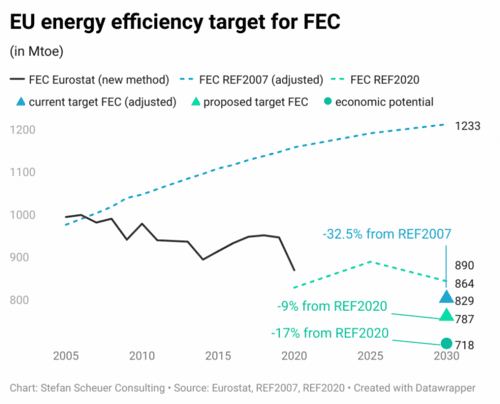
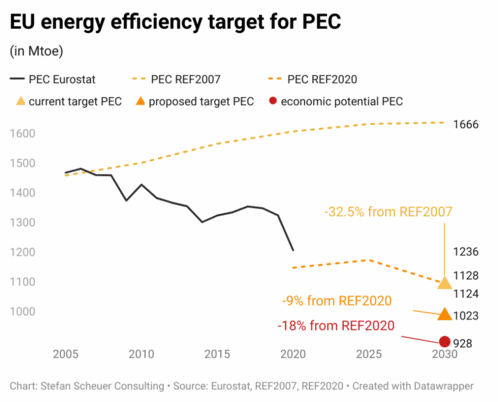
    The European Commission proposed a 2030 EU energy efficiency target of at least 9% below the new REF2020 scenario, in absolute numbers 1023 Mtoe for primary energy consumption (PEC) and 787 Mtoe for final energy consumption (FEC). This level is based on the ‘Mix55’ scenario of the Climate Target Plan. The European Commission states this is the level needed to reach in a cost-effective way the EU 2030 climate target of reducing GHG emission by 55% and ultimately the carbon neutrality target set for 2050.

    This level of ambition:

    • is to be seen as an absolute minimum. Going below would jeopardise the climate neutrality goal and make the clean energy transition more expensive;
    • is well below the cost-effective potential for energy efficiency. According to latest modelling, it would stand at 18% for PEC and 17% for FEC;
    • is built on the current 2030 target gap for FEC. The new baseline EU reference scenario (REF2020) reaches in 2030 a FEC of 864 Mtoe, well above the current target of 829 Mtoe (adjusted to new Eurostat method). According to explanations in REF2020, this difference for FEC is due to unambitious national contributions set by Member States in their NECPs summing up to -29.6% instead of the required -32.5%. The gap for PEC was closed by taking into consideration measures to phase out coal and nuclear. It reaches 1124 Mtoe, which is slightly below the current target of 1128 Mtoe (see graphs below).

    FEC target

    Conclusion:

    • The proposed target level is at the lower end of what is needed to secure a fast, fair and attractive transition to a climate-neutral energy system. A higher target level would be beneficial, in particular to protect the most vulnerable. In order to achieve a higher level, the annual savings in Article 8 need to be adapted accordingly (see position of the Coalition for Energy Savings, January 2022).
    • The binding character of the EU target and national contributions, and a strengthened target governance are key for the success of energy efficiency policy.
    • The REF2020 baseline for FEC is weaker than the current target, due to the gap to meet it. This is a sign of policy failure. The EED recast is the opportunity to improve the governance.

    Download as one-pager (PDF)

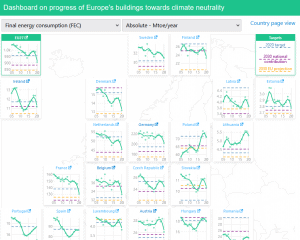
    Dashboard on energy performance of buildings in Europe

    150 150 Almut Bonhage
    Dashboard

    The new dashboard monitors progress of buildings across the EU 27 Member States towards the 2050 net-zero GHG emissions goal with a focus on energy use in residential buildings (75% of the European buildings stock). It shows data since 2005 and will be regularly updated over the coming years. This should normally happen in January, when Eurostat publishes new energy data on energy efficiency. Policy indicators will be updated as new information becomes available.

    Final energy consumption (FEC) data are the central parameter of this dashboard. They are closely linked to the EU’s energy efficiency target and the energy performance of buildings. Data on energy use are collected systematically, robust and regularly updated. The FEC data are complemented by a set of additional qualitative and quantitative indicators, which help to draw a detailed picture of the situation and progress on the ground.

    The Dashboard was developed by Stefan Scheuer Consulting for the European Climate Foundation and first published in June 2021. Data visualisation by Maarten Lambrechts. Latest update: January 2022.

    Buildings dashboard website

    2020 energy consumption plummets as a result of GDP slump

    150 150 Almut Bonhage

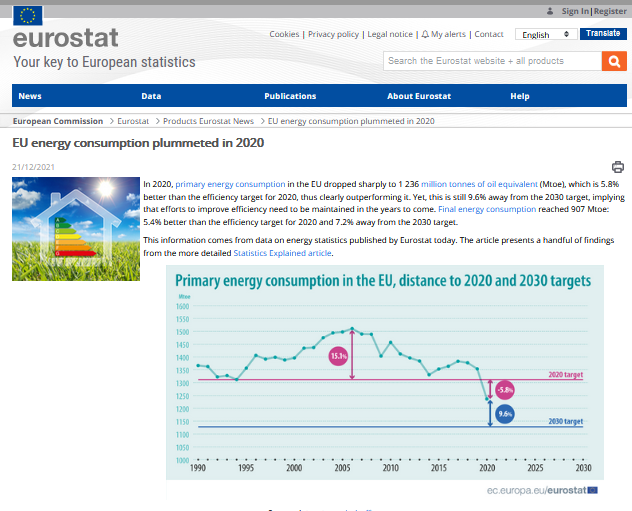
    Eurostat data for Final Energy Consumption (FEC) and Primary Energy Consumption (PEC) 2020 are published. As expected, they show a sharp drop in energy consumption for 2020.

    Eurostat displays the data as “outperforming” the 2020 energy efficiency target of the EU. This presentation is a superficial and misleading reading.

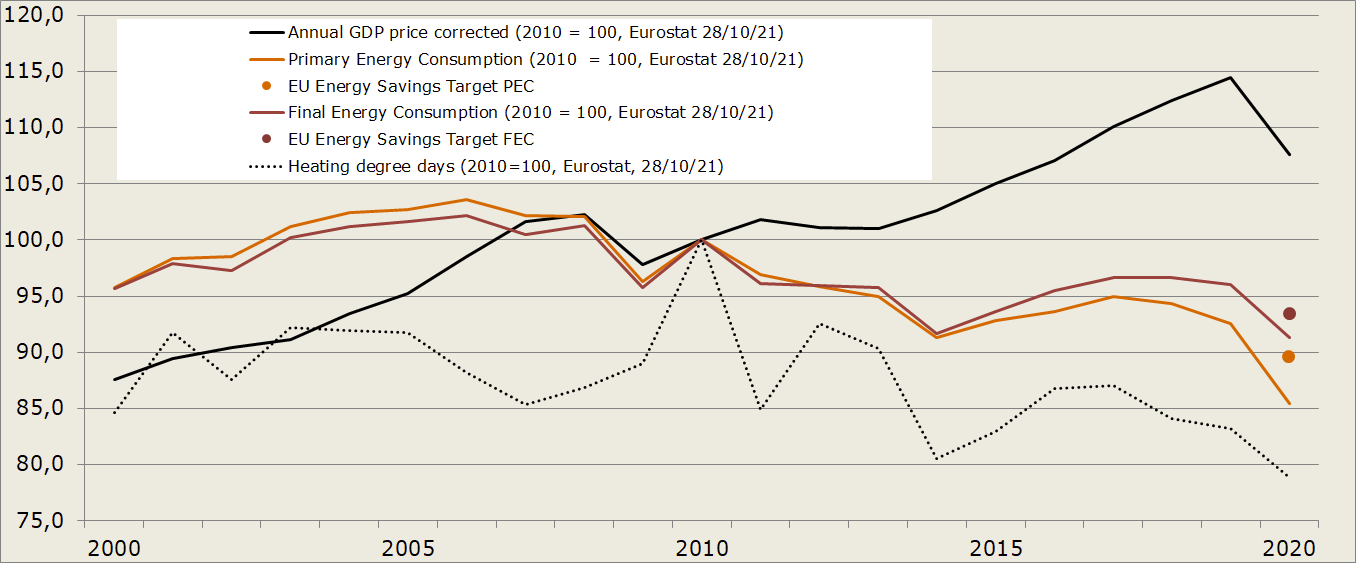
    Covid response measures resulted in a GDP slump, with a strong impact on energy use. Energy consumption dropped in particular in the transport sector. Furthermore, 2020 was a very warm year with a low energy consumption for heating.

    GDP and climate are strong drivers for energy consumption. They need to be considered when interpreting energy consumption development. The decoupling graph below shows this relation. 2020 FEC and PEC figures are put in relation to heating degree days and GDP:

    The 2020 energy consumption figures should not distract us from the fact that Member States are not on track on to meet EU energy and climate goals. Improving the legislation on energy efficiency, and in particular the target governance and enforcement mechanism, is more urgent than ever.

    Stefan Scheuer Consulting has published an assessment of the Fit for 55 package, with recommendations how to ensure target achievement in the future.

    Link Eurostat

    No reason to celebrate 2020 target achievement

    150 150 Almut Bonhage

    The EEA “Trends and Projections 2021” report published earlier this week concludes that all three energy and climate targets for 2020 are achieved. Are they really?

    2020 was a very warm winter, and the Covid crisis reduced economic activity considerably. And weather and activity are strong drivers for energy consumption.

    The decoupling graph provided by Stefan Scheuer Consulting clearly shows this relation. 2020 FEC and PEC estimates by EEA are put in relation to heating degree days and GDP.

    “The decrease in energy demand for 2020 is not a result of an increase in energy efficiency, but a sad accident,” says Stefan Scheuer. “These figures should not distract us from the fact that we are failing to take serious energy efficiency measures.”

    Estimates for 2021 by IEA show that energy demand comes back with economic recovery.

    Improving the legislation on energy efficiency, and in particular the target governance and enforcement mechanism, is more urgent than ever. Stefan Scheuer Consulting has published an assessment of the Fit for 55 package earlier this month, with recommendations how to ensure target achievement in the future.

    Full size graphic FEC/PEC in relation to GDP and heating degree days 2020

    Source: EEA and Eurostat

    Link EEA Trend report

    How to finance Citizen-led Renovation?

    150 150 Almut Bonhage

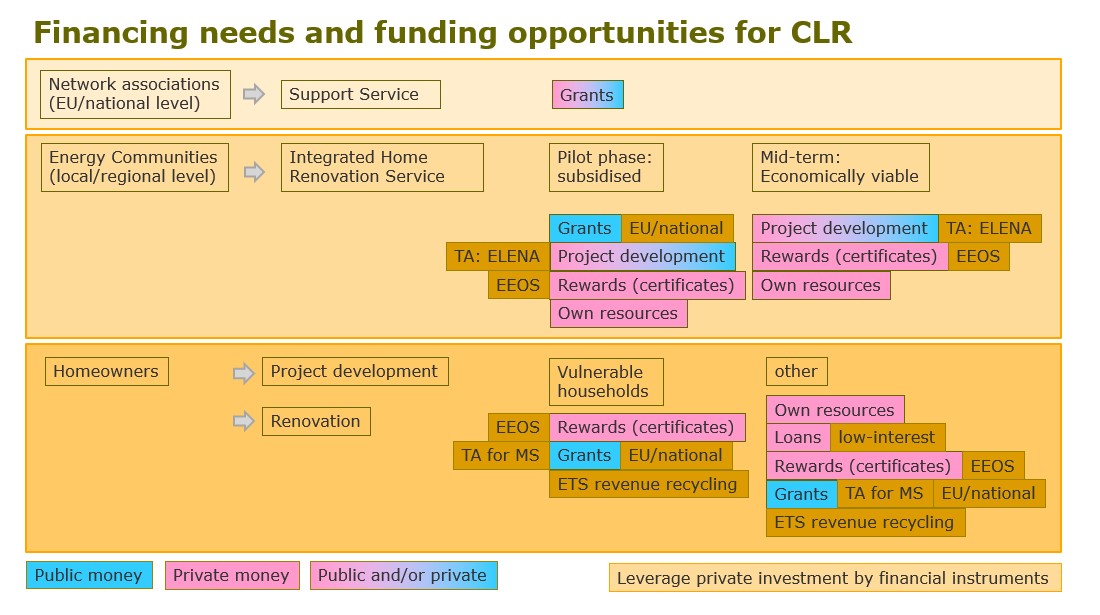
    Throwing money at the problem of slow energy renovations alone won’t solve it. Citizen-led renovation programmes are an approach to create demand for energy renovations on the ground. The financing of the development of such programmes however matters. Stefan Scheuer Consulting has developed a financing guide in order to provide orientation and an overview over the many opportunities available.

    The political context for citizen-led renovation has changed over the last two years since the start of the project. These are the key elements providing new opportunities:

    • In 2020 the EU Climate Law establishes new climate targets, climate neutrality by 2050 and 55% greenhouse gas emission reduction by 2030.
    • The Fit for 55 package includes several provisions that aim at an increase of energy renovations of the existing buildings stock.
      In particular, the proposed EED recast increase the energy efficiency target ambition level and strengthens target governance. Buildings will play an important role to achieve these goals. For a first time, the Commission proposal acknowledges the role of energy communities in the legal provisions.
      Furthermore, the Fit for 55 package proposes a new ETS for the buildings and transport sector which would be linked to a new Social Climate Fund to manage negative social impacts of higher energy prices.
    • The 2021-2027 EU budget foresees several instruments that can be used to finance the renovation wave. At least 30 per cent of both Multiannual Financial Framework (MFF) and Next Generation EU (NGEU), or 547 bn Euro, must be spent for climate purposes.
    • Cohesion and structural funds already applied climate action earmarking during the last budget period. This has been strengthened in the new MFF 2021-2027 and was extended to all regions, including high GDP ones.
    • The EU Recovery and Resilience Facility was put in place in order to help the EU to emerge stronger and more resilient from the current crisis. 37% of the funds are ringfenced for climate investment. The Renovation Wave is one of the components that Member States are encouraged to address in their Recovery and Resilience Plans.
    • The Commission launched a Just Transition Mechanism as part of the European Green Deal with the Just Transition Fund as an instrument to support the territories most affected by the transition towards climate neutrality.
    • The EU supports the energy transition now via the LIFE programme for the environment and climate action. The first call of its subprogramme LIFE Clean Energy Transition was launched in July 2021. It includes several topics that can be used by citizen-led initiatives on energy renovations.
    • The European Parliament’s Committee on Industry, Research and Energy (ITRE) has launched a so-called Pilot Project for a “Support service for citizens-led renovation projects”. The publication of the tender is expected later this year.
    • The EIB’s ELENA tool continues to cover project development costs for sustainable energy investment programmes.

    This document is part of the project ‘Citizen-led Renovation’ by Stefan Scheuer Consulting and REScoop.eu, financed by the European Climate Foundation.

    The project aims to develop an innovative approach building upon existing activities by renewables cooperatives. It started in 2019 as a cooperation between REScoop.eu and Stefan Scheuer Consultancy, financed by the European Climate Foundation. REScoop.eu is reviewing the experience of mature retrofitting programmes run by their member organisations in order to encourage the replication of such programmes. Stefan Scheuer Consulting is analysing the policy development at EU level in order to identify ways to improve the policy framework and financial support for citizen-led renovation.

    Almut Bonhage: A financing guide for Citizen-led Renovation, October 2021

    download

    How to finance Citizen-led Renovation?

    617 818 Almut Bonhage

    This financing guide aims at providing orientation and an overview over the many opportunities on how to finance the development of citizen-led renovation programmes.

    The political context for citizen-led renovation has changed over the last two years since the start of the project. These are the key elements providing new opportunities:

    • In 2020 the EU Climate Law establishes new climate targets, climate neutrality by 2050 and 55% greenhouse gas emission reduction by 2030.
    • The Fit for 55 package includes several provisions that aim at an increase of energy renovations of the existing buildings stock.
      In particular, the proposed EED recast increase the energy efficiency target ambition level and strengthens target governance. Buildings will play an important role to achieve these goals. For a first time, the Commission proposal acknowledges the role of energy communities in the legal provisions.
      Furthermore, the Fit for 55 package proposes a new ETS for the buildings and transport sector which would be linked to a new Social Climate Fund to manage negative social impacts of higher energy prices.
    • The 2021-2027 EU budget foresees several instruments that can be used to finance the renovation wave. At least 30 per cent of both Multiannual Financial Framework (MFF) and Next Generation EU (NGEU), or 547 bn Euro, must be spent for climate purposes.
    • Cohesion and structural funds already applied climate action earmarking during the last budget period. This has been strengthened in the new MFF 2021-2027 and was extended to all regions, including high GDP ones.
    • The EU Recovery and Resilience Facility was put in place in order to help the EU to emerge stronger and more resilient from the current crisis. 37% of the funds are ringfenced for climate investment. The Renovation Wave is one of the components that Member States are encouraged to address in their Recovery and Resilience Plans.
    • The Commission launched a Just Transition Mechanism as part of the European Green Deal with the Just Transition Fund as an instrument to support the territories most affected by the transition towards climate neutrality.
    • The EU supports the energy transition now via the LIFE programme for the environment and climate action. The first call of its subprogramme LIFE Clean Energy Transition was launched in July 2021. It includes several topics that can be used by citizen-led initiatives on energy renovations.
    • The European Parliament’s Committee on Industry, Research and Energy (ITRE) has launched a so-called Pilot Project for a “Support service for citizens-led renovation projects”. The publication of the tender is expected later this year.
    • The EIB’s ELENA tool continues to cover project development costs for sustainable energy investment programmes.

    This document is part of the project ‘Citizen-led Renovation’ by Stefan Scheuer Consulting and REScoop.eu, financed by the European Climate Foundation.

    The project aims to develop an innovative approach building upon existing activities by renewables cooperatives. It started in 2019 as a cooperation between REScoop.eu and Stefan Scheuer Consultancy, financed by the European Climate Foundation. REScoop.eu is reviewing the experience of mature retrofitting programmes run by their member organisations in order to encourage the replication of such programmes. Stefan Scheuer Consulting is analysing the policy development at EU level in order to identify ways to improve the policy framework and financial support for citizen-led renovation.

    Almut Bonhage: A financing guide for Citizen-led Renovation, October 2021

    download

    EEE assessment_title

    New tools to deliver on energy efficiency targets and potentials

    497 718 Almut Bonhage
    EEE assessment_title

    The Fit for 55 package has the potential to deliver on the EU’s energy efficiency targets while the economic energy savings potentials for 2030 are increasing, according to a new study by Stefan Scheuer Consulting and Fraunhofer ISI.

    The proposed recast of the Energy Efficiency Directive increases the EU target ambition, makes the EU level target binding, and introduces potentially powerful target governance tools.

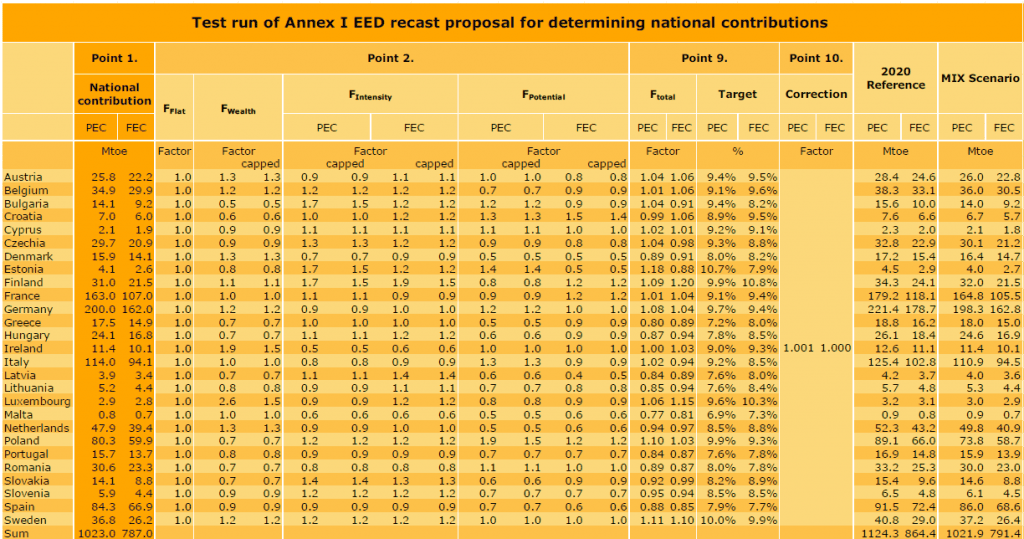
    It includes a formula to allocate the EU’s 2030 energy efficiency targets among Member States. A target allocation is new to energy efficiency but has been used with success for renewable energy and climate targets. But Member States would be allowed to deviate from the results of energy efficiency formula when determining national energy efficiency targets. The EED recast proposal includes a common correction factor, which could be used at the end to adjust national targets and ensure no gap is left to the EU target. But the Commission has not set out when and how it intends to use this tool.

    The proposed EU 2030 energy efficiency-target levels of reducing energy demand by 9% compared to business as usual is an increase from the current 32.5% target to 36% for final energy demand and 39% for primary energy demand. Latest assessments show that economic energy savings potentials have been growing and if tapped would reduce final and primary energy demand by 17% and 18% respectively compared to business as usual.

    The package includes important new elements which boost the delivery of energy efficiency targets. Carbon pricing for buildings and transport if coupled with requirements to use the new revenues, through the new Social Climate Fund to give vulnerable parts of society access to energy efficiency improvements in order to cut their energy bills.

    The study includes the results of a test run of the new formula to allocate the target among Member States (see table).

    Test run of target allocation formula EED

    This report is part of the project ‘Stronger EED Target Governance’ by Stefan Scheuer Consulting and Fraunhofer ISI, financed by the European Climate Foundation. It assesses the Fit for 55 package published by the Commission on 14th July 2021 and provides high-level recommendations for strengthening the target ambition and governance and for increasing the synergies with other pieces of the package.

    This analysis builds on the findings of the first phase of our project, which started in March 2021. The findings are presented in Annex 1 (EED target governance options) and 2 (Energy Savings potentials) to this report. In the first phase, we:
    –   assessed the different governance approaches in EU climate and energy policies;
    –   developed an energy efficiency target benchmarking and allocation approach; and
    –   updated the EU’s and national economic energy savings potentials.

    Wolfgang Eichhammer, Matthias REUTER, Stefan SCHEUER: Will the Fit for 55 package deliver on energy efficiency targets? A high-level assessment, October 2021

    download

    In order to facilitate the use of our website, we use cookies.

    Please confirm if you accept our tracking cookies. When declining the cookies, you can continue visiting the website without sending data to third party services. Read our complete cookie statement here.